
What Is Surrender Value in Life Insurance? A Singapore Guide
Surrender value is the amount your insurer pays if you end your life insurance policy early. Learn how it works, why it may be lower than expected, and what to consider before surrendering a policy in Singapore.
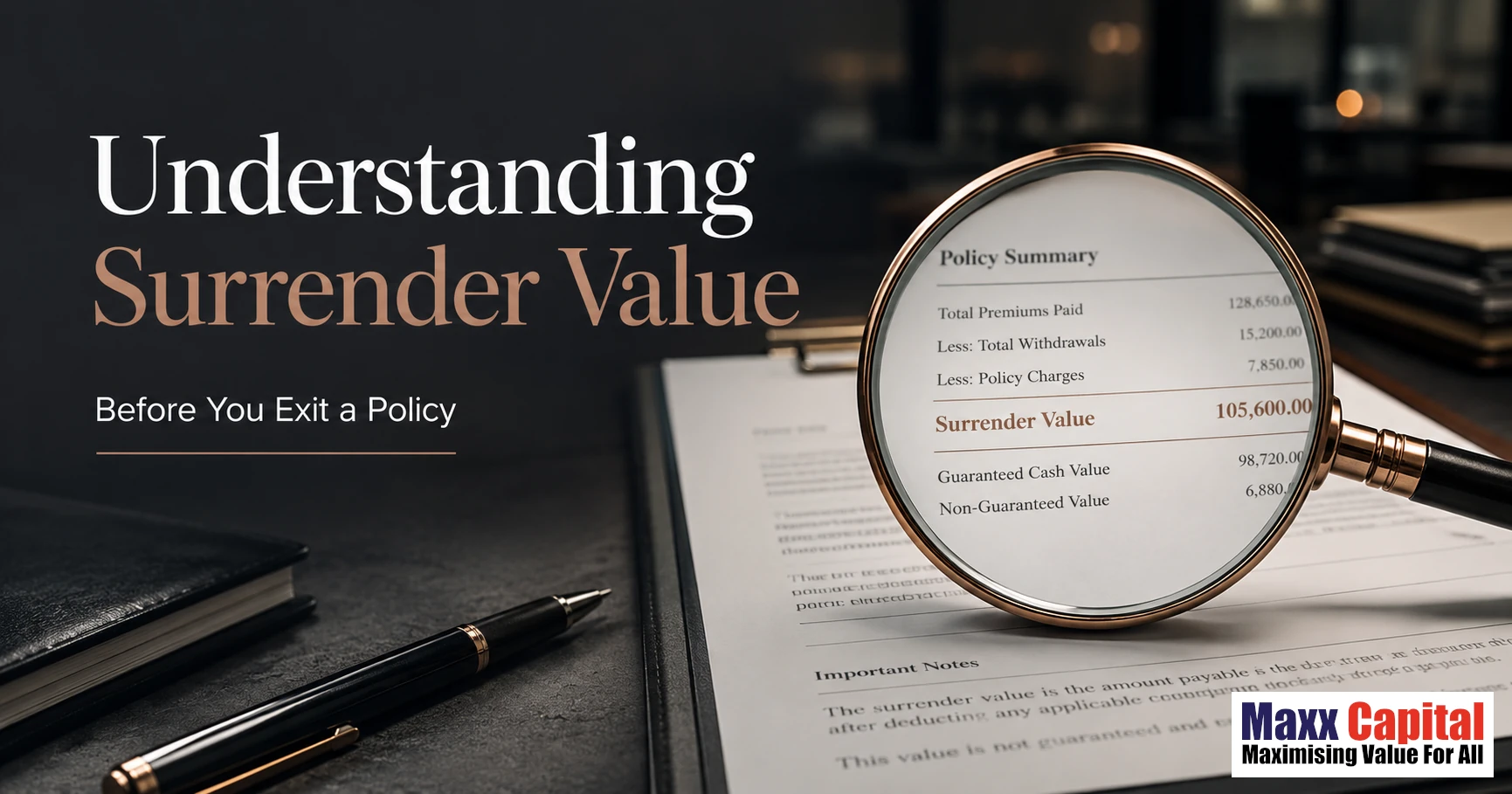
Surrender value is the amount your insurer pays if you voluntarily terminate a life insurance policy before it matures. It is one of the most important numbers to understand before deciding to exit a long-term policy — yet it is also one of the most commonly misunderstood.
Some policyholders assume it equals total premiums paid. Others confuse it with the policy's maturity value or the sum assured. Many only look it up when they are already ready to cancel, leaving little time to compare their options properly.
At MAXX CAPITAL, we believe policyholders should understand surrender value clearly — not just as a number, but as one part of a wider decision. This guide explains what surrender value means, what affects it, and what to consider before acting.
Which Life Insurance Policies Have Surrender Value?
Not every insurance policy builds surrender value. As a general rule:
- Whole life policies, endowment policies, and participating savings plans — typically build cash value over time and may have surrender value
- Term insurance policies — generally provide pure protection with no cash value; surrendering usually returns nothing (or a partial premium refund depending on the insurer)
- Investment-linked policies (ILPs) — may have a surrender value based on the value of underlying fund units, subject to charges
If you are unsure whether your policy has a surrender value, check your policy documents or request the current figure directly from your insurer.
Surrender Value, Maturity Value, and Sum Assured — What's the Difference?
These three figures are frequently confused. Here is a clear comparison:
| Surrender Value | Maturity Value | Sum Assured | |
|---|---|---|---|
| What it is | Amount payable if you end the policy early | Amount payable when the policy completes its full term | Protection benefit payable on death or a covered event |
| When it applies | If you surrender before maturity | At the policy's maturity date | When an insured event occurs |
| Guaranteed? | Partially or fully, depends on policy | May include non-guaranteed bonuses | Usually guaranteed |
| Relevant for early exit? | Yes — this is your reference number | No — you give this up if you surrender | Not directly |
The key takeaway: surrender value is the figure that matters if you are thinking of exiting the policy early. Do not rely on the maturity value or sum assured when making that comparison.
Why Is Surrender Value Often Lower Than Expected?
This is the question policyholders ask most often — and the answer is straightforward once you understand how premiums are allocated.
When you pay premiums into a savings-type life insurance policy, the money does not go directly into a savings account. It typically funds:
- Insurance protection — the cost of the life cover or other covered benefits
- Policy charges — distribution, administration, and management costs
- Savings or investment component — the portion that builds cash value over time
In the early years, a larger portion of premiums covers costs and protection. Less goes toward building cash value. This is why surrender values in the first few years can be significantly lower than the premiums paid — or even zero.
As the policy matures, the balance shifts. More value has accumulated, and the surrender value grows — often more substantially in the later years of the policy term.
The practical implication: if you have held a policy for a long time, the surrender value may be closer to meaningful. If you are in the early years, surrendering may mean recovering very little.
Guaranteed vs Non-Guaranteed Components
Many savings-type insurance policies include both guaranteed and non-guaranteed elements. Understanding this distinction is essential when reviewing surrender value.
Guaranteed components — defined in the policy contract. The insurer commits to paying these amounts regardless of market conditions or fund performance.
Non-guaranteed components — may include future bonus declarations, investment returns, or participating fund performance. These are projections, not commitments. Actual values may differ from what is shown in the policy illustration.
When your insurer provides a surrender value, clarify how much of it is guaranteed. A projected surrender value that includes non-guaranteed bonuses may look more attractive on paper than what you will actually receive.
Surrender Value vs Resale Value
There is one more comparison that many policyholders are not aware of: surrender value is not the same as the value a buyer might offer for the policy in the secondary market.
| Surrender Value | Resale Value | |
|---|---|---|
| Who pays | Your insurer | A buyer in the secondary market |
| Policy outcome | Policy ends | Policy continues under new owner |
| Always available? | Yes, subject to policy terms | Only for eligible policies with buyer interest |
For certain long-term policies — particularly traded endowment policies — a buyer may be willing to pay more than the insurer's surrender value. This is because the buyer values the policy's remaining term and future benefits, rather than simply the early-exit payout.
This is why, for some policyholders, checking whether the policy can be sold before surrendering may recover more value. It is not always possible — not every policy is eligible — but the comparison is worth making. Once you surrender, the policy terminates and the resale option is gone.
What Happens When You Surrender a Policy?
When you submit a surrender request, the insurer processes the policy termination. The sequence is broadly:
- Policy ends — coverage and future premium obligations both cease
- Surrender value is paid — the insurer pays the applicable surrender value, if any
- Future benefits are forfeited — maturity payouts, bonuses, and any remaining protection coverage are given up permanently
One important consideration: if the policy provides life insurance coverage, surrendering may leave a gap in your protection. Replacing that coverage later — especially if your age or health has changed — may cost more or involve medical underwriting.
This is not a reason to avoid surrendering if the policy no longer serves a purpose. But it is a factor worth accounting for before submitting the request.
Common Mistakes to Avoid
Comparing surrender value only against premiums paid
It is natural to measure the surrender value against what you have put in over the years. But the comparison can be misleading. Premiums have funded insurance protection and policy costs, not just savings. The more useful question is: "Given where this policy stands today, what is the best decision from here?"
Assuming surrender value increases in a straight line each year
Policy values do not always grow smoothly. Bonus declarations, policy charges, and the structure of the specific plan all affect how the value builds over time. Some policies may show larger increments at certain points. Do not estimate — request the latest figures from your insurer.
Surrendering without checking whether the policy can be sold
Many policyholders are not aware that some policies can be transferred to a buyer rather than terminated. If your policy may be suitable for resale, it is worth a quick check before surrendering — because once the policy is surrendered, that option is permanently closed.
Ignoring the insurance coverage component
Some policyholders focus entirely on the cash value and overlook the fact that their policy also provides protection. If you still need life coverage or other protection benefits, surrendering may leave a gap that costs more to fill later.
What to Do Before You Surrender
Before submitting a surrender request, work through these steps:
1. Get the current surrender value from your insurer Do not estimate based on old statements. Request an updated figure and confirm how much is guaranteed versus projected.
2. Review what you are giving up Check the maturity date, projected maturity value, any remaining protection benefits, and future bonus potential. Understand the full picture of what surrendering means.
3. Clarify your reason for exiting Are you surrendering because you need cash, cannot maintain premiums, or no longer need the policy? Your reason shapes which option — keeping, surrendering, or selling — makes the most sense.
4. Check whether selling is an option If your policy is a long-term savings policy such as an endowment or whole life plan, it may have resale potential. Submit it for a free assessment before surrendering. If resale is not viable, you can still surrender — but you will do so knowing you have considered all available options.
Is Surrendering Always the Wrong Decision?
No. Surrendering can be the right choice.
If the policy no longer fits your financial goals, if the surrender value is acceptable, if you still need the liquidity, or if the policy has no realistic resale potential — surrendering may be entirely appropriate.
The purpose of reviewing surrender value is not to argue against surrendering at all costs. It is to ensure the decision is made clearly, with an accurate understanding of the numbers, the trade-offs, and the alternatives.
A policyholder who understands their surrender value, their maturity value, and whether resale is an option is in a much stronger position to decide — whatever that decision turns out to be.
If you are reviewing a life insurance policy in Singapore and would like to understand whether selling might be an option before surrendering, request a free, no-obligation policy assessment from MAXX CAPITAL. We will review your policy and give you a clear picture of where you stand.